In the cosmetics industry, consumers no longer buy into promises alone; they expect proven results. Today, brands must be able to substantiate every claim displayed on their packaging, websites, product pages and advertising campaigns.
Who has never come across marketing claims such as:
“92% of sensitive skin users experienced a soothing effect within the first week of use”
“89% of users found their skin firmer and more toned after 28 days”
“91% of volunteers observed a visible reduction in the appearance of wrinkles”
“87% of users reported an immediate tightening effect after application”
“85% of women noticed a reduction in their waist circumference after 28 days of use”
“90% of users found their skin smoother and plumper”
“94% of users considered their skin more hydrated after 7 days”
“88% of testers observed an improvement in skin radiance”
“9 out of 10 users would recommend this product to friends and family”
These claims cannot be used arbitrarily. In Europe, any cosmetic claim must be supported by appropriate and verifiable evidence. Behind every percentage displayed on packaging, websites or advertising campaigns lies a precise evaluation protocol, statistical analysis and a strict regulatory framework.
Whether it is a moisturising cream, an anti-ageing serum, a blemish-control treatment, a haircare product, a slimming product or a beauty supplement, brands must be able to demonstrate the claimed benefits. This is precisely the purpose of consumer testing, clinical studies and efficacy testing carried out before a cosmetic product is placed on the market.
Why Conduct a Cosmetic Consumer Test before product launch?
Consumer testing has become an essential tool in cosmetic product development. Prior to launch, it enables brands to verify whether the formula genuinely meets the expectations of the target audience, whether the claimed benefits are perceived by users and whether the overall experience is compelling enough to encourage purchase and customer loyalty.
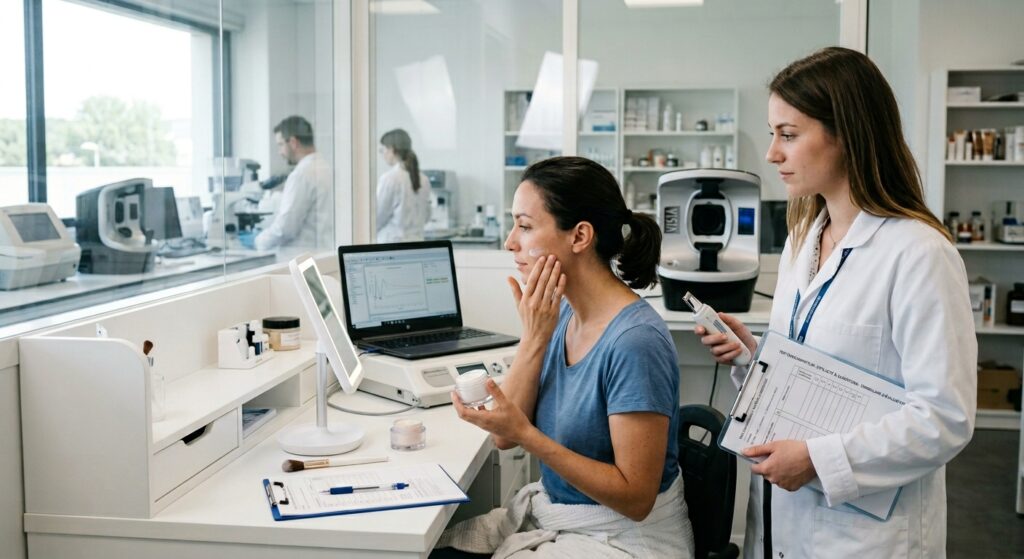
Conducted with a panel representative of your target market, a consumer test assesses how users genuinely perceive the product: perceived efficacy, sensory characteristics, overall satisfaction and repurchase intention. As a valuable decision-making tool, it helps brands validate their positioning, strengthen their arguments and substantiate the marketing claims that will support the product launch.
Two approaches to Cosmetic Consumer Testing
The first consists of entrusting the study to one of our partner laboratories specialising in consumer research. This solution includes volunteer recruitment, definition of selection criteria, questionnaire design, statistical analysis of the results and preparation of a report that can be used for both marketing materials and regulatory documentation.
The second option is particularly suited to content creators, influencers, digital brands and companies that already have an engaged community on social media. It enables studies to be conducted on a larger scale with their audience while increasing consumer involvement in the product development process.
This approach helps reduce costs while strengthening community engagement. However, to ensure that the results can be used in compliance with regulations, the protocol must be rigorously supervised. Our regulatory affairs department supports brands in defining the methodology, validating questionnaires and analysing the data collected.
As with any study involving volunteers, each participant must sign an informed consent form explaining the testing conditions and confirming their agreement to follow the defined protocol.
Defining cosmetic claims before launching the test
An effective consumer test always begins with a clear definition of the claims you wish to substantiate. This step is fundamental as it determines the entire evaluation protocol.
Depending on the product category, the objectives may vary considerably: hydration, radiance, soothing effect, anti-wrinkle action, skin firmness, reduction of imperfections, reduction in hair loss or improvement in the appearance of cellulite.
The most commonly sought-after claims include:
- Skin hydration and comfort
- Visible reduction of wrinkles and fine lines
- Tightening and firming effects
- Skin radiance
- Reduction of redness
- Reduction of hair loss and dandruff
- Improvement in body contour and skin appearance
These objectives will then form the basis for designing the questionnaire intended for volunteers.
How to create a questionnaire for a Cosmetic Consumer Test
The quality of a consumer test depends directly on the quality of the questions asked. Each question must be designed to measure a specific benefit and generate statistically meaningful data.
For a moisturising cream, for example, participants may be asked about their perception of hydration, comfort or skin softness. For an anti-ageing product, questions may focus more on skin firmness, the appearance of wrinkles or the perceived tightening effect.
Following statistical analysis, the results can be translated into marketing claims such as:
“92% of users found their skin more hydrated”
“89% of volunteers reported firmer skin”
“90% of participants found their skin softer after 7 days”
When obtained through a rigorous methodology, these data constitute particularly powerful marketing arguments.
Consumer Test or Clinical Test: what is the difference?
One of the most common misconceptions is to regard a consumer test as a clinical study.
A consumer test evaluates users’ perceptions and satisfaction under real-life conditions of use. It measures perceived benefits such as hydration, firmness, radiance and skin comfort.
By contrast, a clinical or instrumental study is based on objective measurements performed using specialised instruments or expert assessments. It makes it possible to quantify product performance, such as increased skin hydration, reduced wrinkle depth or a decrease in thigh circumference.
This distinction is essential from a regulatory perspective: a claim derived from a consumer test reflects user perception, whereas a clinical or instrumental study demonstrates measured performance.
Blind consumer testing
Blind testing involves evaluating a product without revealing its brand to participants. The objective is straightforward: to assess perception of the formula without any influence from brand awareness, packaging or marketing positioning.
This method is notably used by the Victoires de la Beauté awards, where products are assessed exclusively on perceived efficacy, sensory qualities and user satisfaction.
This approach is an excellent tool for objectively comparing a product with its competitors and highlighting the quality of its formulation.
Complementing consumer testing with efficacy studies
For specific claims, consumer testing alone may not be sufficient. It can be complemented by in vitro or ex vivo efficacy studies to provide additional scientific substantiation.
These studies can be used to evaluate, among other parameters, skin microbiome preservation, antioxidant activity, collagen, elastin and hyaluronic acid synthesis, tyrosinase inhibition, as well as protection against pollution, blue light exposure and specific inflammatory mechanisms.
When combined with consumer testing, they help strengthen the credibility of cosmetic claims and provide an additional level of scientific evidence to substantiate the claimed benefits.
Consumer Testing: A growth driver for your cosmetic brand
Far more than a regulatory requirement, consumer testing is a genuine decision-making tool. It enables brands to validate product-market fit, identify the benefits genuinely perceived by users and strengthen the credibility of claims before launch.
In an increasingly competitive cosmetics market, having access to reliable and actionable consumer data helps reduce the risks associated with launching a product while strengthening consumer confidence.
At Laboratoire Orescience, we support brands at every stage of the process, from defining claims to analysing results, transforming user feedback into tangible evidence that supports commercial performance and brand development.