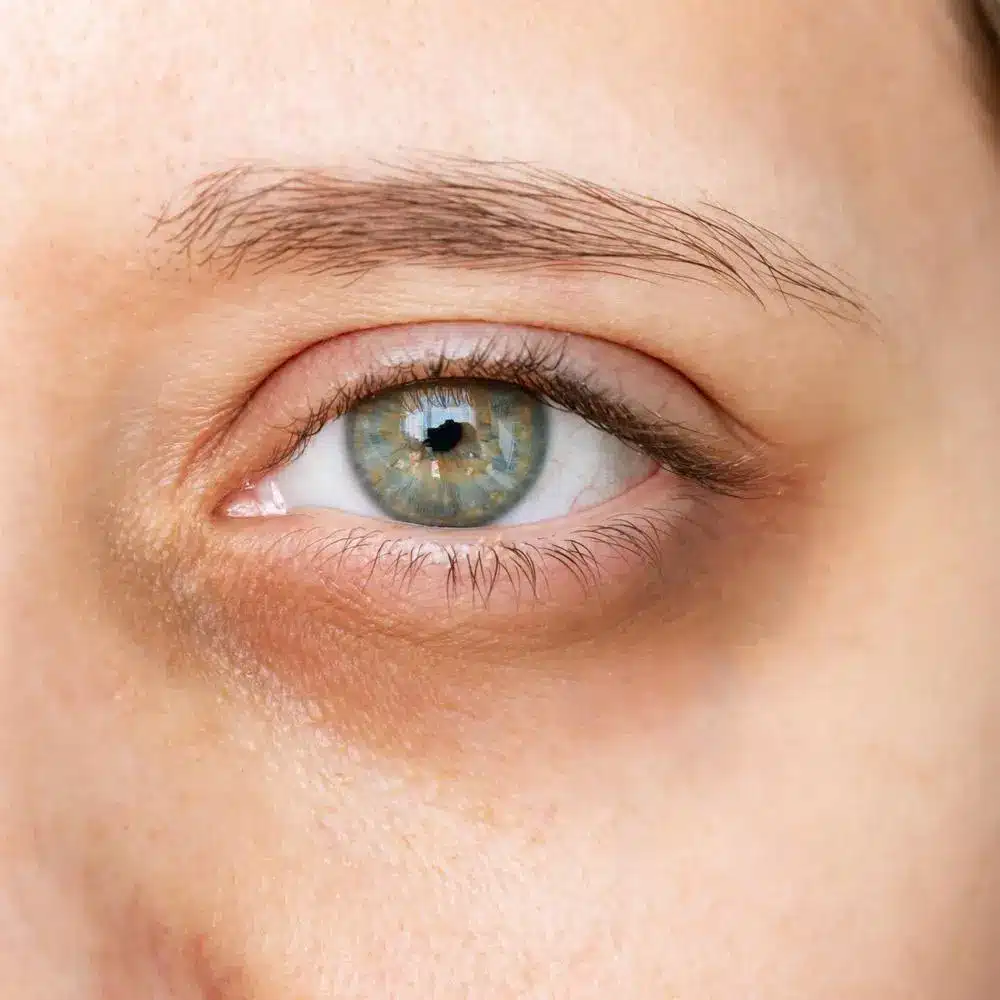
Can vitamin K really reduce the appearance of blue dark circles?
Known for its role in blood clotting, vitamin K has attracted interest in cosmetics for its potential effects on bruising and vascular dark circles.
Vascular dark circles are partly associated with the thin skin around the eyes, which makes the underlying blood vessels more visible. They differ from brown dark circles, which are generally associated with increased pigmentation, and hollow under-eye circles, where the contours of the area accentuate shadows.
Several studies have evaluated formulations combining vitamin K with other active ingredients, such as caffeine, retinol or vitamins C and E. Although some results appear promising, they do not demonstrate the effectiveness of vitamin K when used alone.
To understand the potential benefits of this vitamin and the limitations of the available studies, it is important first to examine what causes blue dark circles.
Why do blue dark circles appear under the eyes?
The appearance of blue dark circles depends on several factors, including the depth of the blood vessels, the characteristics of the skin and the way light interacts with the underlying tissues.
Genetics also plays an important role. In some people, dark circles are visible from an early age, regardless of tiredness or lack of sleep. As we age, thinning skin and loss of volume beneath the eyes can make them more noticeable.
Tiredness can also make dark circles more visible without necessarily being their underlying cause. Similarly, the natural contours of the under-eye area can create shadows that accentuate their colour.
Blue dark circles are therefore not necessarily a sign of poor blood circulation. Their appearance often results from a combination of factors.
Vitamin K and blue dark circles: what is its potential role?
Vitamin K is a fat-soluble vitamin that plays an essential role in blood clotting. This biological function has attracted the interest of researchers, who have investigated the effects of vitamin K-containing preparations on bruising and blue dark circles.
However, its role in blood clotting does not establish that it improves blood circulation or reduces dark circles when applied to the skin. The mechanisms that might explain its potential effects on vascular dark circles remain unclear.
The available studies must therefore be interpreted with caution, particularly as several have evaluated formulations combining vitamin K with other active ingredients.
Vitamin K1, K2 and K3: what are the differences in cosmetics?
Vitamin K refers to a family of fat-soluble compounds that share a common chemical structure. Its two main naturally occurring forms are vitamins K1 and K2, while vitamin K3 is a synthetic derivative.
Vitamin K1, also known as phylloquinone or phytonadione, is produced by plants and other photosynthetic organisms. It is found particularly in green leafy vegetables, including spinach, broccoli and cabbage. This form was used at a concentration of 2% in a clinical study published in 2004 by Mitsuishi and colleagues. The researchers evaluated a formulation combining vitamin K1 with retinol and vitamins C and E to improve the appearance of dark circles and wrinkles beneath the eyes [1].
Vitamin K2, or menaquinone, comprises several compounds produced by certain bacteria, among other sources. It is found in fermented foods and some animal-derived products.
Vitamin K3, also known as menadione, is a synthetic derivative of vitamin K. Due to its potential toxicity, particularly to the liver, it is not used as a source of vitamin K in food supplements intended for human consumption in the European Union.
In cosmetics, vitamins K1, K2 and K3 have different properties and safety profiles. The findings of studies investigating vitamin K1 for blue dark circles therefore cannot be directly extrapolated to other forms of vitamin K.
Scientific reference: [1] Mitsuishi T., Shimoda T., Mitsui Y., Kuriyama Y., Kawana S. (2004). The effects of topical application of phytonadione, retinol and vitamins C and E on infraorbital dark circles and wrinkles of the lower eyelids. Journal of Cosmetic Dermatology.
Vitamin K and blue dark circles: what did the 2004 study find?
To assess the effectiveness of this formulation, the researchers conducted a clinical trial involving 57 Japanese adults with dark circles and wrinkles beneath their eyes. The gel was applied twice daily for eight weeks.
At the end of the study, 27 participants, or 47%, showed an improvement in the parameter described by the authors as haemostasis. A slight reduction in wrinkles was also observed in some participants. However, no clear improvement in pigmentation was found.
These findings must nevertheless be interpreted with caution. The study was open-label, with no placebo group, and the formulation contained several active ingredients. It is therefore impossible to determine whether the observed improvements were attributable to vitamin K1, the other ingredients or their combination.
This study therefore does not demonstrate the effectiveness of vitamin K1 used alone against blue dark circles.
Vitamin K and bruising: what did the 2002 study find?
A clinical study published in 2002 evaluated the effects of a vitamin K-containing cream on bruising caused by vascular laser treatment. The trial, involving 22 patients, was randomised, double-blind and placebo-controlled [2].
The researchers compared the application of vitamin K before and after laser treatment. Each participant applied the cream to one half of their face and a placebo formulation to the other.
The results showed no significant preventive effect when vitamin K was applied before laser treatment. However, application after treatment significantly reduced the severity of bruising, particularly during the first few days.
These findings do not, however, demonstrate that vitamin K reduces blue dark circles. The study investigated bruising caused by a dermatological procedure, rather than dark circles associated with thin skin, the anatomy of the under-eye area or the visibility of blood vessels.
Scientific reference: [2] Shah N. S., Lazarus M. C., Bugdodel R., Hsia S. L., He J., Duncan R. and Baumann L. (2002). The effects of topical vitamin K on bruising after laser treatment. Journal of the American Academy of Dermatology.
Vitamin K and caffeine: what did the 2015 clinical study find?
In 2015, Ahmadraji and Shatalebi evaluated the effectiveness of an under-eye patch containing 3% caffeine and 1% vitamin K in an emu oil-based formulation [3].
The study involved 11 healthy women. For four weeks, each participant applied the active patch beneath the right eye and a placebo patch containing water beneath the left eye.
At the end of the trial, the researchers observed a reduction in the appearance of dark circles and wrinkle depth on the treated side. Participants also reported improvements in the appearance and elasticity of their skin.
These findings must nevertheless be interpreted with caution. The study involved a small number of participants and evaluated a formulation combining several ingredients. It also did not specify whether the dark circles investigated were specifically vascular in origin.
It is therefore not possible to attribute the observed improvements to vitamin K alone or to conclude that it is specifically effective against blue dark circles.
Scientific reference: [3] Ahmadraji F., Shatalebi M. A. (2015). Evaluation of the clinical efficacy and safety of an eye counter pad containing caffeine and vitamin K in emulsified Emu oil base. Advanced Biomedical Research.
Why is vitamin K1 banned in cosmetics in the European Union?
Despite the interest it has generated in research on dark circles and bruising, vitamin K1 carries a risk of skin sensitisation. Following several reports of allergic reactions, France banned its use in cosmetic products in January 2006 [4]. This ban was subsequently extended to the entire European Union under Directive 2009/6/EC of 4 February 2009.
In its scientific opinion SCCP/1105/07, published on 28 September 2007, the Scientific Committee on Consumer Products (SCCP) examined several cases of allergic contact dermatitis associated with preparations containing vitamin K1. Some involved creams applied directly to the eye contour area.
The committee highlighted that sensitisation caused by a cosmetic product could compromise the subsequent administration of vitamin K1 for medical purposes. This risk is particularly concerning because vitamin K1 can be an essential treatment in certain haemorrhagic situations.
The SCCP also concluded that the available data were insufficient to establish a satisfactory safety assessment of vitamin K1 and its so-called ‘oxidised’ form. The latter therefore cannot be presented as an alternative with demonstrated safety.
Regulatory references: [4] Scientific Committee on Consumer Products (SCCP). Opinion on Vitamin K1 (Phytonadione), SCCP/1105/07, 28 September 2007, particularly pages 14–16.
Beyond vitamin K: how can blue dark circles be addressed?
The most appropriate approach to reducing the appearance of blue dark circles depends primarily on their underlying cause. When they are accentuated by under-eye puffiness, skincare products containing caffeine may be beneficial. However, clinical evidence supporting its specific effectiveness against vascular dark circles remains limited.
If the skin around the eyes is dehydrated, products containing glycerine or hyaluronic acid can improve hydration, soften the skin and reduce the appearance of fine lines. Appropriate sun protection also helps prevent UV-induced skin damage.
To conceal bluish discolouration immediately, peach or orange-toned colour correctors offer a simple cosmetic solution. These shades visually neutralise blue tones, making dark circles less noticeable.
However, when dark circles are primarily associated with hollowness beneath the eyes or a loss of volume, cosmetic products cannot correct their underlying anatomical cause. A dermatological consultation may help identify suitable treatment options.
Identifying the predominant cause of dark circles is therefore essential when choosing an appropriate approach and avoiding unrealistic expectations of cosmetic products.
A tailored formulation strategy for every type of dark circle
Blue dark circles, brown dark circles, puffiness or signs of tiredness: each concern affecting the eye contour area requires a tailored formulation approach.
Are you looking for a cosmetic laboratory to develop a custom eye contour product for your brand?
Laboratoire Orescience and its Research & Development department support brands in creating customised cosmetic formulations, selecting active ingredients suited to their objectives, positioning and consumer expectations.
From active ingredient selection to the development of innovative textures, our R&D team creates custom cosmetic formulations tailored to different eye contour concerns, consumer expectations and the regulatory requirements of European, Asian, American and Middle Eastern markets.
Would you like to develop an eye contour product specifically formulated to reduce the appearance of dark circles?
Get in touch to discuss your requirements and develop a tailored formulation for your brand.