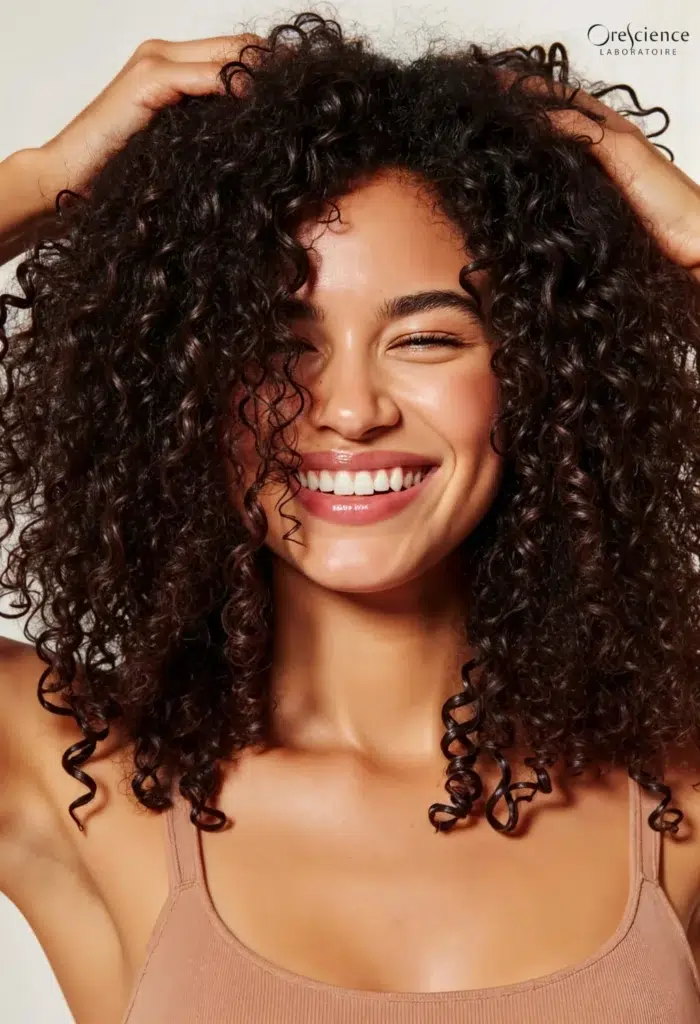
The Curly Girl Method has significantly influenced the way people care for wavy, curly, coily and kinky hair.
Popularised by Lorraine Massey, the Curly Girl Method is based on a simple principle: respecting the hair’s natural texture while limiting practices that may affect its appearance, flexibility or curl definition.
But is it really necessary to follow every rule of the Curly Girl Method to care for curly hair?
From the perspective of cosmetic formulation and hair science, the answer is more nuanced.
Curl type alone is not enough to determine the needs of the hair. Fibre diameter, porosity, the condition of the hair and scalp, and styling habits should also be taken into account.
Understanding the characteristics and needs of your hair is therefore more relevant than systematically following a standardised routine.
Who is Lorraine Massey, the founder of the Curly Girl Method?
Lorraine Massey is a hairdresser specialising in curly hair and one of the figures who has helped shape the way textured hair is cared for and styled.
She is particularly known for co-founding the Devachan salon in New York and for her involvement in creating DevaCurl, a brand dedicated to curly and textured hair.
Lorraine Massey is also associated with the popularisation of the “No Poo” approach, which challenges the routine use of conventional shampoos for curly hair and favours gentler cleansing methods.
This philosophy became one of the foundations of the Curly Girl Method, which she helped popularise through her book Curly Girl: The Handbook.
What is the Curly Girl Method?
The Curly Girl Method is a hair care approach designed for naturally textured hair, including wavy, curly, coily and tightly coiled hair.
It encourages practices that respect the hair’s natural texture, promote curl definition and limit factors that may contribute to dryness, frizz or mechanical stress on the hair fibre.
Its best-known principles include gentle cleansing, conditioning treatments, limiting excessive heat exposure, leave-in products and curl-defining products, as well as drying and styling techniques suited to textured hair.
The method has also helped popularise many techniques and terms now commonly used in curly hair care, including co-wash, low-poo, leave-in, scrunching, plopping, refreshing and cast.
Why does curly hair have specific needs?
The geometry of the hair fibre influences its behaviour, appearance and manageability.
In curly, coily or tightly coiled hair, sebum may be distributed less evenly along the hair fibre than in straight hair. The lengths may therefore be more prone to feeling dry and require appropriate conditioning to facilitate detangling and reduce friction.
However, the shape of the hair alone is not enough to determine its needs.
Hair fibre diameter, cuticle condition, chemical treatments, repeated exposure to heat or UV radiation, and mechanical stress associated with styling can also affect the properties of the hair.
Two people with a similar curl type may therefore have different hair care needs.
Curl type and hair fibre characteristics: understanding your hair
When discussing textured hair, classifications based on the hair’s natural shape provide a useful starting point for describing different hair types.
One of the best known is the Andre Walker Hair Typing System, which distinguishes several hair categories, from straight to tightly coiled hair, primarily according to hair shape and curl pattern.
This classification can help describe the overall shape of the hair and provide some guidance on styling and curl definition. However, it is not sufficient on its own to determine the needs of the hair fibre.
To learn more about different hair types and their classification, read our article “Andre Walker Hair Typing System: developing custom hair care products”.
Curly hair porosity
Porosity refers to the hair fibre’s ability to absorb and lose water. It is influenced by the structure and integrity of the fibre, particularly the condition of the cuticle.
When the cuticle and internal structure of the hair fibre are altered, its interaction with water and the surrounding environment may change. Bleaching, certain chemical treatments, repeated exposure to heat or UV radiation, and mechanical damage can contribute to increased porosity.
Porosity can therefore influence how the hair interacts with water and responds to hair care products. However, the penetration or deposition of an ingredient within or onto the hair fibre also depends on its physicochemical properties and the formulation as a whole.
At-home methods sometimes used to assess hair porosity, such as the float test in a glass of water, should be interpreted with caution. The result can be influenced by numerous factors, and this type of test is not considered a scientifically reliable method for measuring hair porosity.
Hair fibre diameter and condition
Hair fibre diameter and condition also influence the choice of hair care and styling products.
Fine, medium and thick hair may respond differently to hair care and styling products. Fine hair, for example, may be more easily weighed down by formulations rich in conditioning agents, emollients or film-forming agents.
Conversely, a larger-diameter hair fibre does not necessarily require a richer formulation. The appropriate level of conditioning also depends on the condition of the fibre and the desired result.
What routine should you follow when using the Curly Girl Method?
A curly hair routine can combine different cleansing, conditioning and styling products.
The choice of products depends on the characteristics of the hair, the condition of the scalp, styling habits and the desired result.
Gentle shampoo or low-poo for curly hair
Cleansing the scalp is an essential part of a hair care routine.
The aim is to remove excess sebum, impurities and product residue whilst cleansing gently enough to suit both the scalp and the condition of the hair lengths.
The term “low-poo”, commonly used in textured hair care, generally refers to a shampoo designed to cleanse gently. However, it is not a cosmetic product category defined by regulation.
Co-washing for curly hair
Co-washing involves using a product that combines gentle cleansing with conditioning properties.
It may be suitable for some curly, coily or tightly coiled hair types that benefit from gentle cleansing combined with additional conditioning.
A specifically formulated co-wash should not be confused with a conventional conditioner, which is primarily designed to condition the hair and facilitate detangling. The cleansing performance of a co-wash depends on its composition and surfactant system.
The choice between a co-wash and a shampoo should therefore take into account scalp condition, washing frequency, the styling products used and the level of cleansing required.
Conditioner and hair mask for curly hair
Conditioner facilitates detangling, reduces friction between hair fibres and improves softness, flexibility and manageability.
A hair mask is generally formulated to provide a richer treatment and additional conditioning for the mid-lengths and ends.
The richness of the treatment should be suited to the characteristics of the hair fibre. Formulations that are too rich may weigh down certain hair types and contribute to product build-up.
Leave-in conditioner for curly hair
A leave-in conditioner is a treatment applied after washing and left on the hair without rinsing. It is generally applied to damp or wet hair to facilitate styling and improve softness and manageability.
Available as a spray, milk or cream, a leave-in conditioner should be selected according to the characteristics of the hair and the level of conditioning required.
Curl-defining cream for curly hair
A curl-defining cream is a styling product designed to enhance curl formation and definition while helping to control frizz.
Depending on the formulation, it may also provide conditioning and flexibility.
Styling gel and jelly for curly hair
A styling gel or jelly provides hold, promotes curl definition and helps control frizz.
During drying, certain film-forming or styling polymers may create a temporarily rigid film around the hair strands, commonly known as a “cast”. Once the hair is completely dry, the cast can be softened by gently scrunching the hair to reduce stiffness whilst maintaining curl definition.
Curly Girl Method: should you really avoid sulphates and silicones?
The Curly Girl Method traditionally recommends limiting the use of certain sulphate surfactants and silicones in curly hair routines.
From a cosmetic formulation perspective, however, this approach requires a more nuanced assessment. The presence or absence of a particular family of ingredients is not sufficient, on its own, to determine the gentleness, performance or suitability of a product for curly hair.
Silicones and curly hair
Silicones are a diverse family of ingredients with a wide range of properties. Depending on the type of silicone and the formulation in which it is used, silicones can facilitate detangling, reduce friction, improve shine and help control frizz.
Silicones are therefore not inherently unsuitable for curly hair. Their suitability depends on the type of silicone, its concentration and the formulation in which it is incorporated.
Sulphates and shampoos for curly hair
Sulphate surfactants do not all have the same properties, and their presence alone does not determine how gentle a shampoo is.
The gentleness and cleansing performance of a surfactant system depend on the nature and concentration of the surfactants, their combination, the pH and the formulation as a whole.
A shampoo containing sulphate surfactants is therefore not necessarily unsuitable for curly hair. Conversely, a “sulphate-free” claim does not, on its own, guarantee a gentler formulation.
How can you adapt the Curly Girl Method to your hair?
The Curly Girl Method should be tailored to the characteristics and condition of the hair, as well as the needs of the scalp.
Ease of detangling, perceived dryness, curl definition, volume and product build-up are all useful indicators when adjusting a routine.
Washing frequency, shampoo cleansing performance, the level of conditioning provided by treatments and the hold provided by styling products can then be adjusted gradually.
The Curly Girl Method is therefore best regarded as a flexible framework rather than a fixed protocol for every hair type.
From the Curly Girl Method to formulating products for textured hair
The success of the Curly Girl Method reflects a wider shift in the hair care market towards products better suited to the diversity of wavy, curly, coily and tightly coiled hair.
For a cosmetics brand, developing products for textured hair requires consideration of hair fibre characteristics, target performance, sensory properties and styling habits.
Developing private label and custom hair care products for curly hair
Laboratoire Orescience supports brands in developing and manufacturing hair care products for wavy, curly, coily and tightly coiled hair, through both private label solutions and custom formulation.
Depending on the project brief and positioning, our R&D team can develop a range of hair care products, including:
- gentle shampoo or low-poo
- clarifying shampoo
- co-wash
- conditioner
- hair mask
- leave-in conditioner
- curl defining cream
- styling gel or jelly
- hair serum
- hair oil
Each formulation is developed with consideration for target performance, sensory properties, stability, packaging compatibility and the regulatory requirements applicable in the countries where the product will be marketed.
Laboratoire Orescience’s expertise also extends to projects intended for commercialisation in Europe, Africa, the Middle East and Asia.
Are you looking to create a range for curly hair or develop a specific hair care product?
Discover our expertise in custom hair care formulation and private label manufacturing.