With the explosion of TikTok Shop, social media, Shopify and independent brands, many entrepreneurs now believe it is possible to launch a cosmetic brand with only a few dozen or a few hundred units. In just a few clicks, it is now easy to create an online store, build an attractive visual identity and quickly reach first customers through social media.
The reasoning often seems straightforward: a trendy formula, attractive packaging, a few viral videos… and sales will follow.
However, when moving from concept to the reality of cosmetic development, things quickly become far more technical. Behind every product lie formulation, manufacturing, regulatory and logistics constraints that are not always visible on social media.
One of the recurring questions received by the Laboratoire Orescience sales department concerns minimum order quantities, commonly referred to as MOQs. Many entrepreneurs wonder why a cosmetic laboratory cannot manufacture just a few dozen or a few hundred units, especially at a time when everything seems flexible and fast in today’s digital landscape.
We regularly receive requests such as:
- “ I would like to launch 100 units of a facial serum to test the market. The idea would be to start with a controlled initial volume, validate the product with customers, then gradually increase production.”
- “ Could you manufacture 300 shampoos with several fragrance variants, along with a few 5 ml samples for influencer campaigns and consumer testing? ”
- “ I would like to add a trending active ingredient to one of your white label formulas, produce 200 units and launch the brand ahead of summer.”
- “ Is it possible to produce a pilot batch with a few customised bottles? I would like premium packaging to test the final appearance. ”
- “ I do not need the PIF because I will only sell on TikTok Shop and social media. ”
At first glance, these requests may appear simple, especially in a market where everything now seems fast, flexible and accessible. Yet behind every production run lie significant industrial, technical and regulatory constraints.
Adding an active ingredient to a cosmetic formula requires research and development, stability testing and compatibility assessments between the formula and its packaging. Modifying a fragrance, texture or bottle can also affect production and may require additional quality controls.
Today, digital tools have made launching a cosmetic brand far more accessible. However, cosmetic manufacturing remains a highly regulated industrial activity involving fixed costs, technical constraints and significant regulatory requirements.
We also explore this topic in our article: TikTok in cosmetics: accelerator of success or a trap?
It is this industrial reality that explains why laboratories impose minimum production quantities (MOQs).
What is an MOQ in the cosmetics industry?
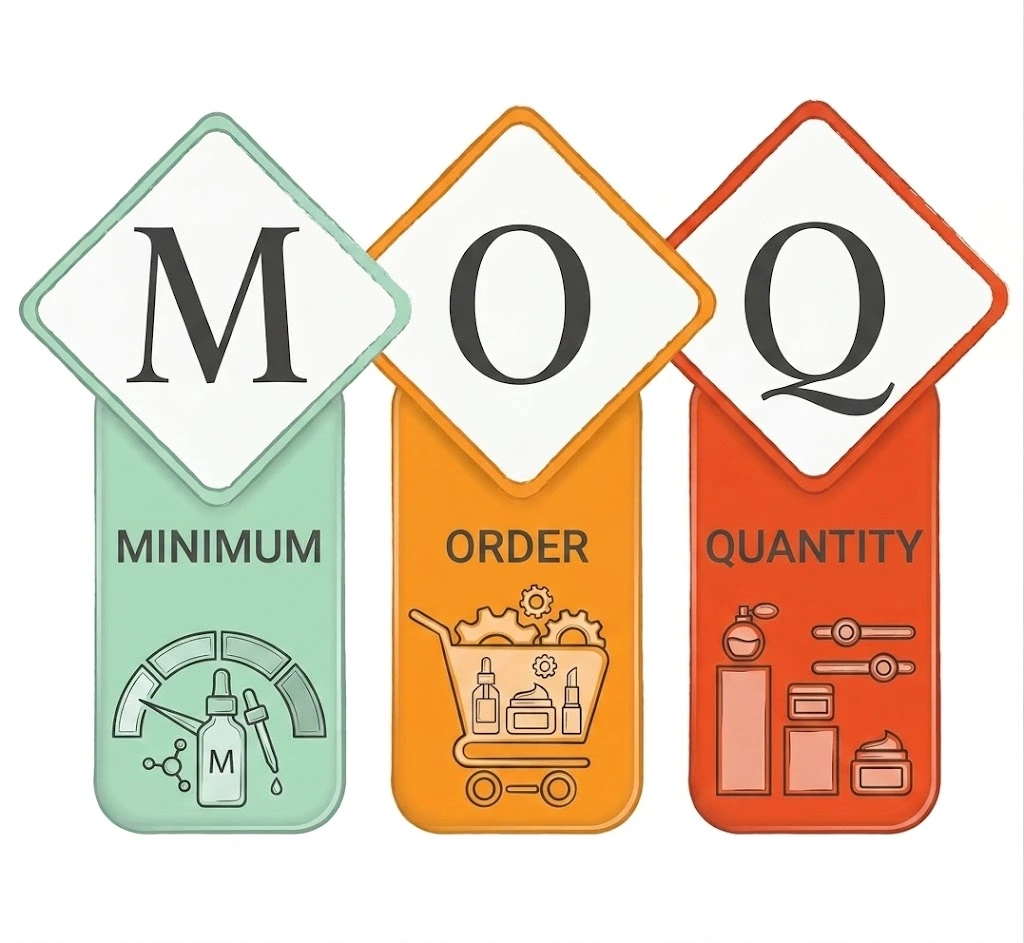
In industry, the term MOQ stands for “Minimum Order Quantity”. It refers to the minimum volume required by a supplier, manufacturer or cosmetic laboratory in order to initiate production.
In practical terms, the entire cosmetics supply chain operates with minimum order quantities. Primary packaging, cartons, raw materials, fragrances and active ingredients: every supplier imposes its own MOQ, which may also vary depending on the level of customisation or finishing required.
A cosmetic laboratory therefore cannot simply order a few hundred grams of an active ingredient or manufacture 100 custom packaging units for a very small production run. Laboratories themselves are also dependent on the minimum quantities imposed by suppliers, as well as the constraints associated with industrial manufacturing.
MOQs are therefore not arbitrary limitations imposed by laboratories. They are directly linked to the industrial realities of cosmetic manufacturing, including sourcing, production, quality control, traceability and regulatory compliance.
The industrial constraints of cosmetic manufacturing
Every production run requires teams, industrial equipment, preparation time, machine set-up, cleaning procedures, filling operations and quality controls.
Whether Laboratoire Orescience manufactures 300 units or several thousand, the industrial processes remain broadly the same: tank preparation, raw material weighing, equipment cleaning, quality controls, batch traceability, compliance testing and filling line organisation. These manufacturing constraints, combined with the requirements of the wider supply chain, explain why cosmetic laboratories impose minimum order quantities (MOQs).
When creating a cosmetic brand, it is therefore essential to think not only about the product itself, but also about the business model, launch volumes and the brand’s overall strategy. We explore this topic in more detail in our article: Creating a cosmetic brand: Strategy before formula.
Why custom packaging increases MOQs
Today, many brand founders want a “premium” look and feel from the very beginning of their launch. In fact, this is a term that frequently appears in requests received by Laboratoire Orescience, without always clearly defining the expected level of finishing.
In industrial terms, “premium” packaging can involve various levels of finishing and customisation, including bottle screen printing, hot stamping, UV varnish, soft-touch finishes, embossing, metallisation or even the development of fully custom packaging.
However, this level of customisation creates additional production constraints.
The more advanced the level of customisation and finishing, the higher the minimum production quantities required by suppliers. Producing a small batch with custom packaging or specific finishes can therefore quickly lead to significant industrial constraints and increased production costs.
Why small quantities increase unit costs
Many emerging brands want to start with small quantities in order to limit their initial investment. At first glance, the approach seems logical.
However, in industrial manufacturing, producing very small batches significantly increases the unit cost.
A production run of 300 units requires almost the same resources as a much larger production run.
Conversely, higher volumes allow manufacturing costs to be distributed more efficiently, optimise raw material and packaging purchasing, improve overall profitability and support a more competitive selling price within the cosmetics market.
Cosmetic regulations are often underestimated
Beyond production, packaging and manufacturing cost constraints, regulatory requirements are also frequently underestimated when launching a cosmetic brand.
However, non-compliance can lead to serious consequences, including product recalls, import refusals, formal notices, regulatory sanctions and legal liability for the brand.
We explore this topic in more detail in our article: Cosmetic product recalls in Europe: Causes and common mistakes
Social media often creates an oversimplified view of the cosmetics market
With TikTok, Shopify and the rise of content creation, launching a cosmetic brand now appears more accessible than ever. A few videos, attractive packaging and an online store can quickly create the impression of a well established brand.
However, what social media rarely shows are the industrial realities behind a cosmetic product: formula development, manufacturing, regulatory compliance, packaging, inventory management, logistics, advertising and customer acquisition costs.
This digital exposure can sometimes lead entrepreneurs to underestimate the true complexity of launching a cosmetic brand and the industrial constraints involved. We also explore this topic in our article: Launching your brand on TikTok: Viral success or legal risk?
The role of a cosmetic laboratory goes far beyond manufacturing
At Laboratoire Orescience, we support both entrepreneurs discovering the cosmetics industry through the launch of their first brand and companies already established across national and international markets.
Our role extends far beyond manufacturing alone. Developing a cosmetic product requires a deep understanding of the industry’s industrial realities, including European regulations, formula development and performance, packaging compatibility, quality controls, manufacturing processes, industrial costs, logistics, regulatory compliance, marketing positioning and overall brand strategy.
Today, digital tools and social media can sometimes create the impression that launching a cosmetic brand is fast and straightforward. Yet behind every product lie technical, regulatory and industrial realities that require a genuine understanding of both the market and its constraints.
This is why we place great importance on guidance, education and helping our clients understand the realities of the industry. We work with brand founders who take the time to build their business coherently, with a thoughtful approach and a solid understanding of cosmetic development challenges.
And this is often how the most sustainable brands are built. Many of the companies we support today began with carefully controlled production volumes aligned with their launch strategy and growth capacity. By taking the time to structure their brand, understand the realities of the sector and gradually scale their business, they later expanded across France, into mass retail and sometimes far beyond European borders.
These journeys illustrate a reality that is often underestimated within the cosmetics industry: the true challenge is not simply launching a brand, but building a company capable of growing, structuring itself and evolving sustainably within a highly demanding market.
This is the vision of cosmetic development that we support every day at Laboratoire Orescience.