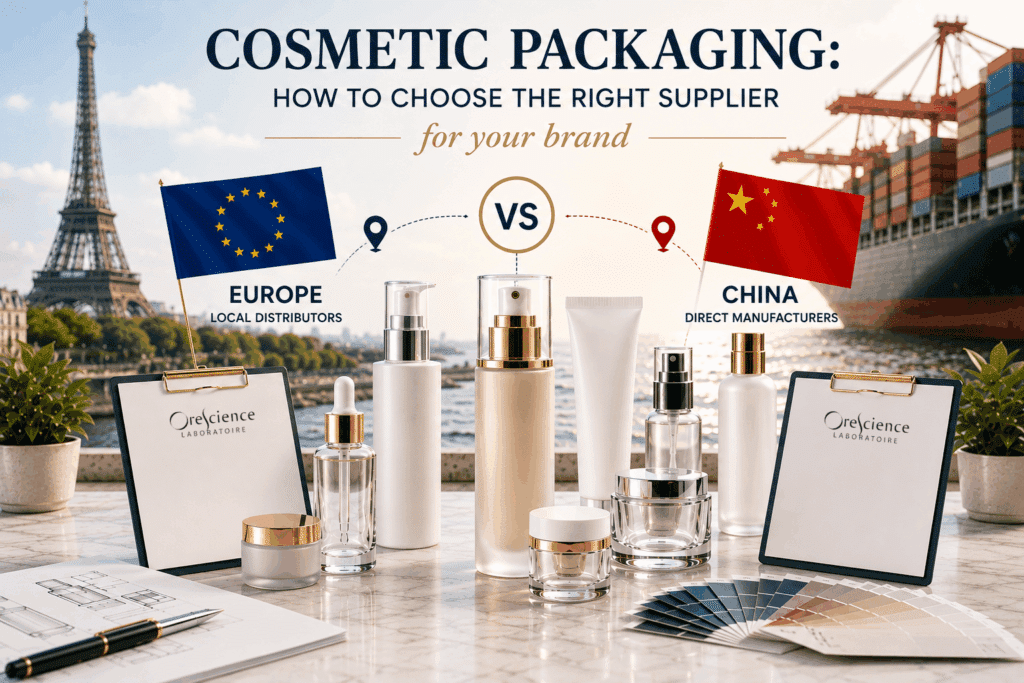
The choice of packaging is often approached from a design, marketing or user experience perspective. However, for a cosmetic manufacturing laboratory, it is first and foremost an industrial decision that will influence manufacturing, logistics, regulatory compliance, production costs and even a brand’s ability to support its long-term growth.
At Laboratoire Orescience, one request comes up very frequently during the initial discussions with project owners:
“We are looking for Premium packaging.”
This request is entirely legitimate. However, it immediately raises an initial question:
What does Premium packaging actually mean?
For some brands, it simply refers to an elegant bottle. For others, it means thicker glass, a premium-quality pump, silk-screen printing, varnishing, hot stamping, metallisation, a soft-touch finish or even fully bespoke packaging.
In reality, the term Premium has no industrial definition. Every level of finishing involves specific manufacturing processes, different suppliers, particular technical constraints and, in many cases, higher minimum order quantities.
This is often when a second surprise arises: a cosmetic laboratory is not a packaging manufacturer. Its role is to identify and select, from a network of specialist manufacturers and distributors, the solutions best suited to each project.
In practice, a cosmetic laboratory mainly works with two major categories of partners. The first consists of raw material manufacturers and distributors, who supply the ingredients required for formula development. The second includes packaging manufacturers and distributors, responsible for producing the bottles, jars, pumps, caps, sticks, roll-on applicators and Airless systems used to package cosmetic products. Each partner has its own industrial constraints, production lead times and minimum order quantities, all of which must be taken into account by the laboratory from the earliest stages of the project.
Packaging constraints therefore do not depend solely on the laboratory. They are also imposed by the entire supply chain. This explains, in particular, why certain packaging solutions are only available above specific order quantities. We explore this industrial reality in greater detail in our article “Cosmetic MOQs: Why Laboratories Impose Minimum Order Quantities“, which explains how MOQs operate within the cosmetics industry.
Before even proposing packaging to its client, the laboratory evaluates numerous criteria. Beyond aesthetics, it assesses the supplier’s reliability, the long-term availability of references, the quality of the technical documentation, procurement lead times, regulatory requirements and the compatibility between the packaging and the formulation.
European Sourcing: A reliable solution for many projects
The first approach is to work with a European distributor specialising in cosmetic packaging.
Contrary to popular belief, a large proportion of the packaging marketed in Europe is manufactured in Asia. The difference lies in the distributor’s role. The distributor selects the manufacturers, imports the products, holds inventory in Europe, carries out quality control inspections and provides all the technical documentation required for cosmetic product development.
For a brand, this organisation offers numerous advantages. Delivery times are generally shorter, transport costs remain under control and the costs associated with sending samples are significantly lower than with international sourcing. Technical documentation is readily available, making it easier to carry out regulatory testing, particularly compatibility studies between the formulation and its packaging.
Another advantage, often underestimated, concerns product continuity. Established distributors generally market the same product ranges for many years. This stability enables brands to source exactly the same packaging for future production runs without having to search for a new bottle.
This is particularly important once a brand begins building customer loyalty. Packaging plays a key role in brand identity. Frequently changing bottles may undermine brand recognition and, depending on the nature of the modifications, could require new regulatory compatibility testing before the product can be placed back on the market.
Clearance, Overstock and End-of-Series packaging: A good opportunity?
There are also distributors specialising in the sale of packaging originating from industrial surplus.
These references generally come from standard production runs held in stock, excess manufacturing volumes, discontinued product lines or end-of-line packaging that has been replaced by new collections.
These solutions can sometimes offer particularly attractive prices and may represent an excellent opportunity for certain projects.
However, this approach has one significant limitation: there is no guarantee that the same reference will still be available a few months later.
For a one-off project, this solution may be perfectly suitable. However, for a brand aiming to build a long-lasting product range and maintain a consistent brand identity, it is essential to take this factor into consideration from the outset.
Customising your packaging: when should you consider sourcing from Asia?
European distributors provide an excellent solution for a large proportion of projects. However, when a brand wishes to develop fully customised packaging, featuring a specific colour, complex silk-screen printing, hot stamping, metallisation, a soft-touch finish or even an exclusive mould, sourcing directly from Asian manufacturers often becomes the most appropriate solution.
Today, Alibaba has established itself as the world’s leading platform for connecting buyers with suppliers. However, successful sourcing on this platform requires genuine expertise in international procurement.
Not every company listed on Alibaba performs the same role. The platform includes manufacturing factories, trading companies, sourcing agents and various intermediaries. One of the first steps is to identify the actual packaging manufacturer. Whenever possible, working directly with the manufacturer generally helps reduce intermediaries, improve cost control, streamline communication and ensure better production follow-up.
From approximately 5,000 units onwards, direct sourcing in Asia generally becomes more competitive. It is also at these production volumes that customisation opportunities become far more attractive, whether in terms of colours, finishes, decorative options or the development of exclusive packaging.
Beyond price: How should you assess a packaging supplier?
Purchase price is, of course, an important consideration, but it should never be the sole deciding factor.
A good supplier is first and foremost an industrial partner. Beyond competitive pricing, they must be capable of delivering consistent quality, meeting production deadlines, providing comprehensive technical and regulatory documentation, and supporting your brand’s growth without compromising supply continuity.
When purchasing through Alibaba, we recommend selecting suppliers that are covered by the Alibaba Trade Assurance programme. This protection helps secure transactions, particularly in cases of shipping delays or where the goods delivered do not comply with the specifications agreed at the time of ordering.
For large-scale production runs, it is also strongly recommended to arrange an independent factory quality inspection before shipment. Although this represents an additional cost, it often prevents far more significant financial consequences.
Ordering samples is also an essential step. Depending on the type of packaging and the finishes requested, a budget of between US$70 and US$100, including shipping, should generally be expected. Beyond evaluating the quality of the packaging itself, this initial order also provides an opportunity to assess the supplier’s professionalism, communication, packaging standards, shipping efficiency and the accuracy of the documentation supplied.
FOB, CIF, DAP and DDP: understanding Incoterms before importing
Choosing a supplier is only one part of the process. The importation of the goods must also be properly organised.
Incoterms define the respective responsibilities of the seller and the buyer throughout the entire logistics chain.
For most projects, FOB (Free On Board) or CIF (Cost, Insurance and Freight) terms provide greater control over international transport and customs clearance procedures.
DAP (Delivered At Place) terms provide for delivery to the agreed destination, while DDP (Delivered Duty Paid) terms also include customs clearance formalities. Although the latter may appear particularly convenient, it requires increased vigilance. In certain cases, non-compliant customs practices may expose the importer to legal liability.
The choice of an Incoterm should therefore never be based solely on the quoted price. It forms an integral part of the overall sourcing strategy.
Choosing the right packaging supplier also means preparing your brand’s future
International packaging sourcing should never be improvised. Identifying the right manufacturers, assessing their reliability, verifying their regulatory compliance, organising quality inspections and managing import operations all require time, experience and a trusted network of partners.
For more than 25 years, Laboratoire Orescience has been building and expanding this network across both Europe and Asia. Our manufacturing partners are selected through a rigorous qualification process and are regularly audited by our teams to ensure they consistently meet stringent standards of quality, regulatory compliance and reliability. This organisation enables our clients to benefit immediately from a proven and dependable supply chain, without having to identify, qualify and coordinate each supplier themselves.
Our role extends far beyond manufacturing your cosmetic products. We are committed to securing your entire supply chain and every industrial process required to enable your brand to grow sustainably, both across Europe and internationally.